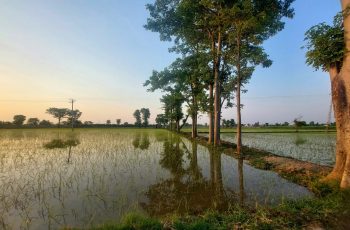
In August 2026, the Food Securities Fund made its first investment in Asia, financing a well-established rice processor in South Asia working with smallholder farmers on regenerative agriculture practices, access to certified seeds and water management practices under the Sustainable Rice Platform standard. The borrower is also in advanced preparations to unlock carbon finance under a Paris Aligned Crediting Methodology (PACM) Article 6 arrangement, applying the recently updated Gold Standard DREAM methodology. The borrower sells rice to clients in the EU, US, and UK, where a longstanding FTSE 100 client supported the transaction.
Rice is one of the most important staple foods globally. It supports an estimated 4 billion people and 144 million jobs, most of it grown by smallholder farmers in Asia. It is both vulnerable to environmental change (including drought, flood, and heat) and a driver of environmental pressure in its own right, through over-fertilization, methane and nitrous oxide emissions, and water over-abstraction. Sustainable rice production practices can address these environmental challenges while generating positive impact for rice farmers and processors. They require upfront resourcing, including quality seed and agronomic support delivered to farmers as goods and services. The Food Securities Fund enables this by providing pre-harvest working capital.
Given its importance, rice production has the focus of policy makers, research institutions and donor efforts. FAO has published extensively on methane emissions in rice systems, and recently launched a program with the Climate & Clean Air Coalition (CCAC) under the Global Methane Pledge. IFC has built a dedicated body of work on sustainable rice markets and financing including benchmarking of the Sustainable Rice Platform standard against IFC Performance Standards. The World Bank has placed climate-smart rice at the center of its Climate Change Action Plan and highlighted country-level results at scale. In 2025, ADB, CGIAR, and the Gates Foundation jointly committed up to USD 1.5 billion to improve rice productivity and reduce its water and carbon footprint across Asia and the Pacific. Temasek and Temasek Foundation have also made significant investments in rice in the region, for example.
Initiatives like Sustainable Rice Platform are critical to building demand for more sustainable rice production and channeling incentives through the supply chain, with retailers such as Lidl GB (UK), Costco and Walmart promoting the certification. This needs to be complemented with financing that helps translate policies and implement sustainable practices in rice supply chains. Clarmondial has been highlighting the need for additional capital to flow, including through a 2022 report “Scaling private sector investment in sustainable rice: needs and opportunities,” as well as through Clarmondial Director Tanja Havemann’s role on the board of the Sustainable Rice Platform. We are glad that the Food Securities Fund, to which Clarmondial is the investment adviser, has made its first contribution to this effort.